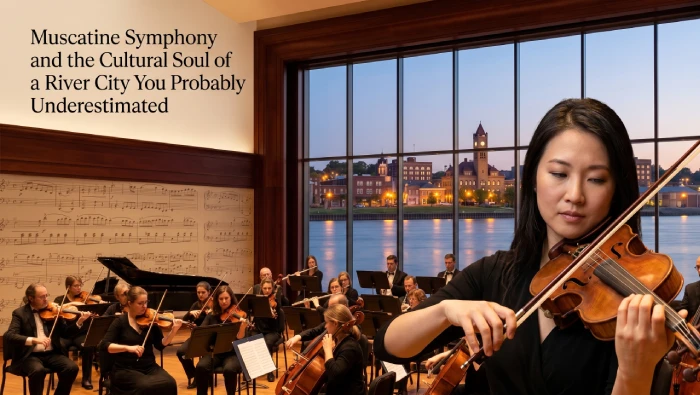
A musician with the Muscatine Symphony Orchestra prepares during a concert, reflecting the community-driven spirit that has sustained the ensemble for over six decades in Muscatine, Iowa.
Meet Muscatine – Travel and Culture Guide – Tucked along the Mississippi River in eastern Iowa, Muscatine is a city that most travelers drive past without a second glance, yet it hosts a symphony orchestra that has been performing for over six decades, drawing audiences from three surrounding counties and generating an estimated $1.2 million in local cultural economic activity annually according to Iowa Arts Council data from 2023.
Muscatine’s identity is layered in ways that catch outsiders off guard. Once known as the Pearl Button Capital of the World, the city produced over 37% of the globe’s freshwater pearl buttons at its industrial peak in the early 1900s, harvesting mussels directly from the Mississippi. That heritage of craftsmanship, precision, and community pride didn’t disappear when the button factories closed. It quietly transferred into the city’s cultural institutions, including its symphony.
Today, Muscatine’s population sits around 22,500, a modest Midwestern number that belies the density of cultural programming packed into its calendar. The city maintains a robust parks system, a revitalized downtown riverfront, and institutions like the Muscatine Art Center, which houses one of Iowa’s most significant permanent art collections. Understanding Muscatine means understanding that it operates on a scale where every cultural institution carries disproportionate community weight.
Founded in 1958, the Muscatine Symphony Orchestra (MSO) has sustained itself through economic downturns, demographic shifts, and the general cultural headwinds that have shuttered similar regional orchestras across the American Midwest. According to the League of American Orchestras, roughly 30% of regional orchestras with budgets under $500,000 faced serious operational threats between 2015 and 2023. The MSO is not among the casualties, and that survival deserves scrutiny.
What keeps the MSO alive is a combination of strong volunteer musicianship, consistent community fundraising, and a programming philosophy that resists elitism. A typical MSO season runs from September through April, featuring four to six major concerts at the Muscatine High School Auditorium, which seats approximately 1,200. Attendance per concert averages 600 to 800 people, a fill rate that many mid-size city orchestras would envy. The orchestra draws musicians from Muscatine, Davenport, Iowa City, and even across the river from Illinois, creating a genuinely regional ensemble rather than a purely local one.
When we attended a fall season opener, the experience was immediately grounding. There is no velvet rope culture here, no dress code anxiety, no institutional distance between the audience and the stage. Families arrived in jeans alongside retired couples in blazers. The pre-concert lobby conversation was genuinely warm, the kind of community ritual that metropolitan orchestras try to manufacture and rarely achieve authentically.
The programming that evening blended a Brahms symphony with a commissioned piece from a local Iowa composer, a choice that reflected MSO’s deliberate effort to bridge canonical classical music with regional artistic identity. The conductor, working with mostly volunteer and semi-professional musicians, achieved ensemble cohesion that surprised first-time attendees. The brass section in particular drew audible appreciation during the Brahms. This is not a novelty act. It is a functioning orchestra delivering genuine musical experiences on a modest budget.
Read More: Orchestra industry data and regional ensemble survival trends in America
Contrary to the assumption that bigger cities produce better cultural experiences, there is a documented pattern in American arts administration showing that orchestras in cities with populations between 15,000 and 50,000 frequently achieve higher audience-to-population ratios than their metropolitan counterparts. A 2022 study from the National Endowment for the Arts found that per-capita arts attendance in non-metropolitan communities exceeded urban averages by 14% when controlling for income levels. The explanation is sociological: in smaller cities, a symphony concert is a genuine community event rather than one entertainment option among hundreds. Every seat filled represents a neighbor, not just a ticket number.
The Muscatine Symphony benefits directly from this dynamic. There is no competition from a NBA game, a major touring concert, or a dozen restaurant openings pulling attention away on the same Saturday night. The MSO is, on its concert weekends, the cultural center of gravity for the entire city. That concentration of community attention creates an atmosphere that money genuinely cannot replicate in larger markets. For visitors planning a trip around an MSO concert experience in Muscatine, this is the core promise: intimacy at scale.
Imagine you are a couple based in the Quad Cities, about 30 miles west, looking for a genuinely different Saturday night. The logistics around an MSO concert make for a complete day: arrive in Muscatine by mid-afternoon, walk the Mississippi River overlook at Riverside Park, visit the Muscatine Art Center before its 5 PM weekend closing, grab dinner at one of the downtown restaurants along 2nd Street, and arrive at the auditorium for a 7:30 PM curtain. Total driving time from the Quad Cities is under 35 minutes. The experience costs a fraction of a comparable night in Chicago or Des Moines, and it trades urban anonymity for something increasingly rare: the feeling of being welcomed into a community’s living room.
For out-of-state visitors, Muscatine sits along the Great River Road National Scenic Byway, making it a natural anchor for a Mississippi River cultural itinerary. The MSO typically announces its season schedule by August each year, with tickets available through the MSO website and at the door. Ticket prices have historically remained accessible, ranging from $10 to $25 for general admission, a deliberate pricing philosophy that the MSO has maintained to protect community accessibility.
Muscatine is proof that cultural richness does not scale linearly with city size. A symphony that has outlasted dozens of larger-market peers, a pearl button heritage that still shapes civic identity, and a Mississippi River setting that frames every visit with natural drama combine to make this one of the Midwest’s most underestimated cultural destinations. The Muscatine Symphony Orchestra is not a consolation prize for travelers who couldn’t make it to Chicago. It is a distinct and valuable experience in its own right, one that rewards the traveler willing to exit the highway. The real question is not whether Muscatine is worth visiting. It is why you haven’t visited yet.
Meet Muscatine - Amidst the industrial hum along the Mississippi River, a distinct sound resonates every season that challenges Muscatine's…
Meet Muscatine - Established in 1915, the Muscatine Symphony Orchestra stands as a testament to endurance, currently uniting over 200…
Meet Muscatine - As the lights dim at the historic Central Auditorium, over 600 local residents settle into their seats,…
Meet Muscatine - While the industrial legacy of the Pearl Button City often dominates historical narratives, recent economic indicators suggest…
Meet Muscatine - While the Pearl of the Mississippi is widely celebrated for its industrial history and button factories, a…
Meet Muscatine, Muscatine - There is a distinct rhythm to this Mississippi River town that goes beyond the flow of…