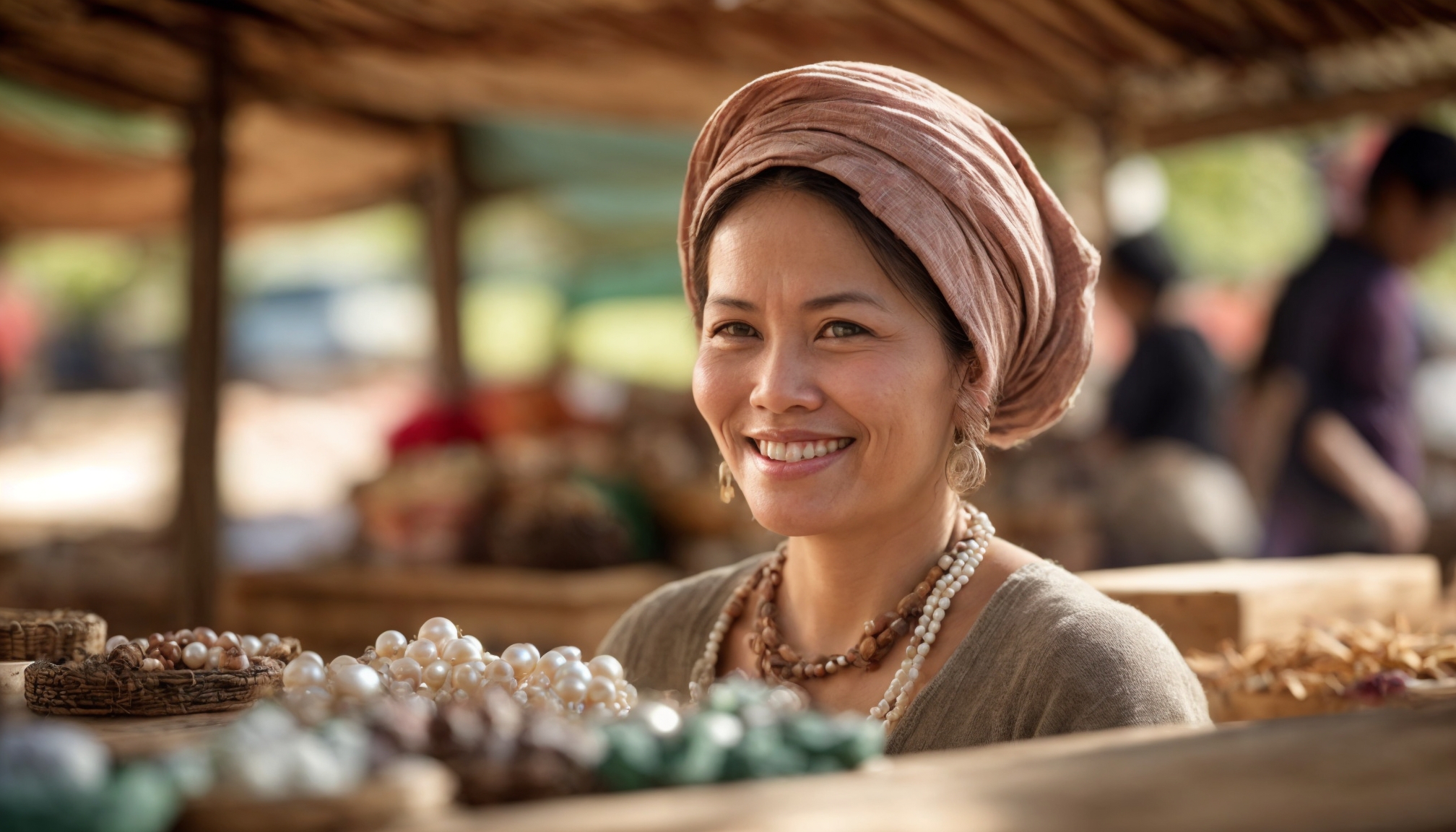
The Muscatine farmers market along the Mississippi riverfront serves as the city's weekly public square, where cultures and generations meet every Saturday morning.
Meet Muscatine – Travel and Culture Guide – Muscatine, Iowa draws fewer than 24,000 residents according to the 2020 U.S. Census, yet this riverside city punches far above its weight when it comes to cultural richness and social vitality. Visitors who expect a quiet Midwestern backwater routinely leave surprised, even transformed, by the layered community life they encounter along the Mississippi.
Most small American cities inherit a single dominant narrative, a mill town, a railroad hub, a farming community, and never escape it. Muscatine defies that pattern. It carries at least three distinct identities simultaneously: a 19th-century pearl-button manufacturing capital that once supplied 40% of the world’s freshwater pearl buttons, a gateway community for Chinese immigrants whose influence stretches back to the 1970s when Xi Jinping first visited as part of an agricultural exchange delegation, and a living-museum of Victorian architecture that the National Register of Historic Places has recognized repeatedly.
That layering matters because it generates a kind of cultural friction that keeps communities intellectually alive. When a city has to negotiate competing histories, it develops the habit of asking hard questions about identity, belonging, and memory. Muscatine has been doing exactly that for over 150 years, and the practice shows in how its residents engage with one another.
The Muscatine History and Industry Center preserves more than artifacts from the pearl button era; it preserves the social logic of an industrial community where entire families worked alongside each other cutting and polishing freshwater mussel shells. That shared labor history created a horizontal solidarity across class lines that still echoes in how local organizations function today: flat, participatory, and quick to mobilize around a shared cause.
When Xi Jinping returned to Muscatine in 2012 as China’s Vice President, he reportedly said it was the place where his ‘first impression of America was formed.’ That moment put a city of fewer than 24,000 people on a geopolitical map. More practically, it deepened sister-city ties with Zhongshan, China, funding exchange programs that have brought dozens of Chinese students into local schools and sent Muscatine students abroad. The cross-cultural literacy that results is measurable: Muscatine High School reported a 34% increase in Mandarin language enrollment between 2013 and 2019.
Cultural identity is only meaningful when it translates into lived social behavior. Spending time observing Muscatine’s social infrastructure reveals something counterintuitive: the city’s relatively small size creates a density of social connection that larger cities actively spend millions trying to recreate through urban design initiatives.
The Muscatine Farmers Market, held every Saturday morning from May through October along the riverfront, is not merely a commercial event. It functions as the city’s primary weekly public square. Vendors, many of them Latinx families who represent the fastest-growing demographic in Muscatine County (up 28% between 2010 and 2020 according to Census data), interact with third-generation German-American farm families, recent Bosnian refugees, and retirees who have lived on the same block for five decades. The market is, in effect, a weekly rehearsal of civic pluralism.
The Muscatine Art Center, housed in a 1908 Edwardian mansion paired with a modern wing, reported over 18,000 visitors in its most recent full operational year. For a city of Muscatine’s size, that figure represents roughly 75% of the entire population passing through a single cultural institution annually, a penetration rate that would be extraordinary in any metropolitan context. The Center’s programming deliberately targets social cohesion: its community gallery rotates work from local artists of all backgrounds, ensuring that the walls reflect the full demographic complexity of the city rather than a curated elite.
More than 40 congregations operate within Muscatine city limits, representing Protestant, Catholic, Muslim, and non-denominational traditions. Rather than existing as parallel social universes, many of these communities collaborate through the Muscatine Center for Social Action (MCSA), which coordinates food assistance, housing support, and immigration services. The MCSA model is worth studying: it treats faith communities not as competitors for souls but as complementary nodes in a shared civic network, a structure that researchers at the University of Iowa’s School of Social Work cited in a 2021 report on rural community resilience.
Muscatine’s event calendar is dense enough to suggest a city twice its size. The Riverfront Criterium cycling race draws competitive cyclists from across the Midwest each summer, temporarily transforming downtown streets into a venue that mixes athletic spectacle with neighborhood block-party energy. The Muscatine Sesquicentennial celebrations and recurring Heritage Days events draw on the city’s layered history, presenting pearl-button demonstrations, river ecology exhibits, and multicultural food programming under the same tent.
What distinguishes Muscatine’s festivals from the generic ‘small-town fair’ template is intentional curation. Organizers consistently program across demographic lines, ensuring that a Vietnamese food vendor, a Sudanese drumming group, and a bluegrass quartet appear on the same schedule. That curation is not accidental. It reflects a deliberate civic strategy: if the festival feels like everyone’s festival, everyone comes, and social trust compounds.
Read More: How the National Register of Historic Places protects America’s cultural heritage
Most travel and culture pieces about Muscatine focus on the pearl-button story and the Xi Jinping connection because those are the easiest hooks. What they consistently miss is the structural reason Muscatine’s social life works: the city has never been wealthy enough to let any single institution dominate its cultural landscape. No single employer, no single donor family, no single ethnic group has had the resources to colonize civic life. That constraint, which might look like poverty from the outside, has functioned as a kind of democratic forcing mechanism.
Compare this to river cities of similar size that did attract dominant institutional capital. Many of them report higher income levels but lower civic participation rates, hollowed-out downtowns where wealth concentration replaced community investment. Muscatine’s relative scarcity of concentrated wealth distributed the work of culture-making across hundreds of small organizations, families, and volunteers. The result is a city where social life is genuinely co-produced rather than consumed.
Researchers studying post-industrial Midwestern cities have begun flagging Muscatine as an outlier case in community resilience literature. A 2022 working paper from Iowa State University’s Department of Community and Regional Planning identified Muscatine as one of three Iowa cities demonstrating ‘above-baseline social cohesion metrics despite below-median household income,’ attributing this partly to the density of volunteer-led cultural organizations relative to population size. The city had over 60 registered nonprofit organizations as of 2023, roughly one for every 390 residents.
Understanding Muscatine’s culture intellectually is one thing; actually entering it requires a different approach than visiting a typical tourist city. The institutions are real but the experiences are participatory, meaning passive observation will leave you at the surface.
The Mississippi riverfront is Muscatine’s living room. Arrive on a Saturday morning between 8 and 11 a.m. from late May through October and the farmers market will be running. Do not just buy produce. Talk to vendors about where they are from and how long they have been in Muscatine. In three hours of conversation at the market, it is possible to hear five or six different native languages and encounter family stories that span three or four continents. That density of human geography in a single outdoor space is genuinely unusual.
The Art Center’s evening programming, including lectures, openings, and community dialogues, draws a cross-section of Muscatine that daytime visits do not always capture. Attendance at a single program evening will introduce you to city council members, retired factory workers, university students on placement, and recent immigrants, often in the same conversation. Budget two hours, arrive before the formal program starts, and let the pre-event social period do its work. That is where the real cultural intelligence of Muscatine becomes visible.
Muscatine carries three overlapping historical identities, pearl-button manufacturing heritage, Chinese-American diplomatic connections, and a strong Latinx and immigrant community, that few cities of its size can match. This layered history generates a cultural conversation that is unusually complex and ongoing. The city’s over 60 nonprofits serving fewer than 24,000 residents also means cultural participation is structurally built into daily life rather than reserved for special occasions.
It is more than symbolic. The sister-city relationship with Zhongshan, China, has produced concrete programming in local schools, including documented 34% growth in Mandarin enrollment between 2013 and 2019. The Muscatine China Friendship Association organizes ongoing cultural exchange events, and several local businesses maintain direct trade relationships with Chinese partners. Xi Jinping’s personal connection to the city remains a source of civic pride and occasional diplomatic attention.
Yes, but active participation yields far more than passive sightseeing. The Saturday farmers market, Muscatine Art Center programs, and seasonal festivals are all designed for public engagement. Visitors who arrive with curiosity and time for conversation will find Muscatine residents exceptionally open about their city’s history and present-day complexity. A two-day visit that includes a market morning, a museum afternoon, and an evening event will provide a genuinely rounded picture.
Late spring through early fall, roughly May through September, is when the cultural calendar is most dense. The farmers market runs, outdoor festivals concentrate, and the riverfront becomes a genuine social space. That said, the Muscatine Art Center runs programming year-round, and the city’s indoor cultural institutions, including the History and Industry Center, operate in all seasons. Winter visits offer a quieter, more intimate experience of the community’s indoor social life.
Muscatine County’s Latinx population grew 28% between 2010 and 2020, making it one of the fastest-growing demographic groups in the region. That growth has visibly reshaped the farmers market, the restaurant landscape, local faith communities, and school programming. Several Spanish-language cultural events now anchor the annual calendar, and bilingual civic communication has become standard practice for city services. The influence is structural, not decorative.
Muscatine’s social life and culture resist easy summary precisely because they are genuinely alive, shaped by competing histories, multiple languages, and hundreds of small acts of civic investment every week. The city is not a cultural destination in the traditional sense. It is something rarer: a community where culture is the byproduct of people who actually need each other. If Muscatine social life and culture is on your radar, the most honest advice is simple: show up, stay curious, and let the city surprise you.
Meet Muscatine, Muscatine - The Muscatine Symphony community music scene has anchored the city's cultural calendar for over two decades,…
Meet Muscatine, Muscatine - The Muscatine Symphony Orchestra has quietly built a reputation that rivals ensembles twice its budget, drawing…
Meet Muscatine - Amidst the industrial hum along the Mississippi River, a distinct sound resonates every season that challenges Muscatine's…
Meet Muscatine - Established in 1915, the Muscatine Symphony Orchestra stands as a testament to endurance, currently uniting over 200…
Meet Muscatine - As the lights dim at the historic Central Auditorium, over 600 local residents settle into their seats,…
Meet Muscatine - While the industrial legacy of the Pearl Button City often dominates historical narratives, recent economic indicators suggest…